←
Kiran Chadwick-Rupp
science studio
Science Studio Play by Hatch Coding
Why
Context
Science and coding are often taught through explanation before experience. Students are asked to understand abstract concepts through diagrams, worksheets, or videos, with interaction arriving later, if at all.
For many learners, especially younger ones, abstraction becomes friction before intuition has time to form. Science Studio Play is the interactive mini-game layer of the larger Science Studio platform, designed to reverse this common learning pattern.
Intent
Science Studio Play was created to start learning where curiosity naturally begins, with interaction.
Instead of rewarding correctness, the focus is on experimentation, feedback, and discovery. Turning abstract ideas into simple interactive systems where students build intuition through use and play.
Role
Science Studio Play acts as a playful learning layer.
It does not replace teaching. The games are intended to help learners internalize ideas through repeated interaction, making formal instruction easier to understand when it arrives.
System
Science Studio Play is a collection of short, focused concepts.
Each activity communicates a single scientific or computational idea through behaviour rather than text. Students change inputs, observe outcomes and try to beat scores.
Challenge
Teaching real-world scientific concepts through a digital medium is unintuitive by default.
Ideas like gravity, energy, and motion are felt physically before they are understood conceptually. Learned through weight, resistance, failure, and physical observation. Translating that embodied learning into a screen-based interaction risks turning experience into abstraction.
There was also a larger question: is it even useful to teach these concepts digitally?
The answer emerged through making. Digital systems allow students to learn science and computer science at the same time. By manipulating variables, observing outcomes, and inspecting code, students build some intuition for physical systems while, importantly learning how systems and concepts are represented computationally.
Gamification
Not every activity in Science Studio was designed to function as a lesson.
All activities were conceptualized in response to CrunchLabs build kit science toys and Mark Rober’s approach to learning, using curiosity, spectacle, and play as the entry point, while layering understanding underneath.
Each toy, was intentionally split into two types of experiences. Three that were concept-driven, designed to isolate and communicate a specific scientific idea. Three that were game-driven, inspired by the behaviour of the toy itself.
This balance was deliberate. Pure instruction risks disengagement. Pure play risks losing meaning. Learning requires a balance between reflection and flow.
The goal was to use play as a gateway to learning.
Process
Each activity began with a single concept and a question:
What interaction would make this idea feel obvious?
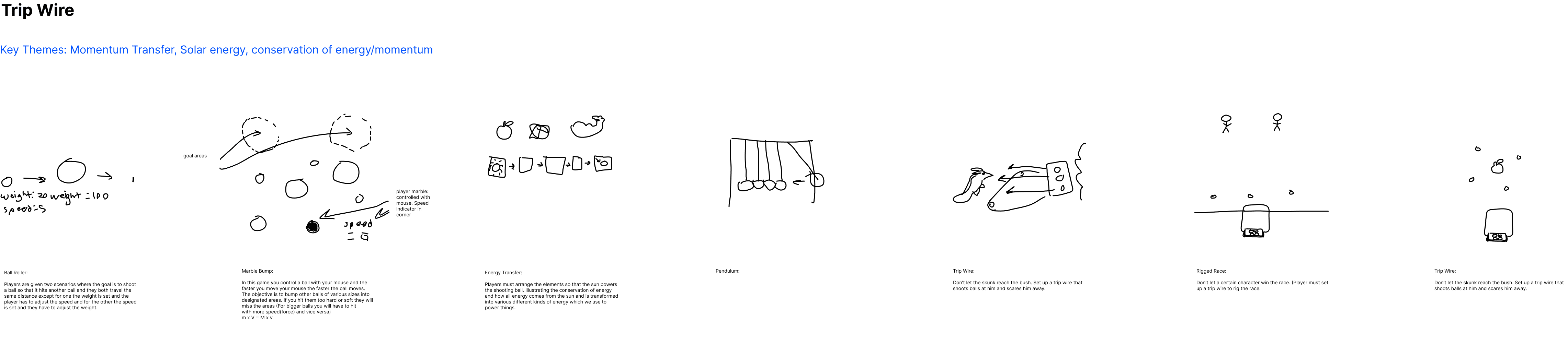
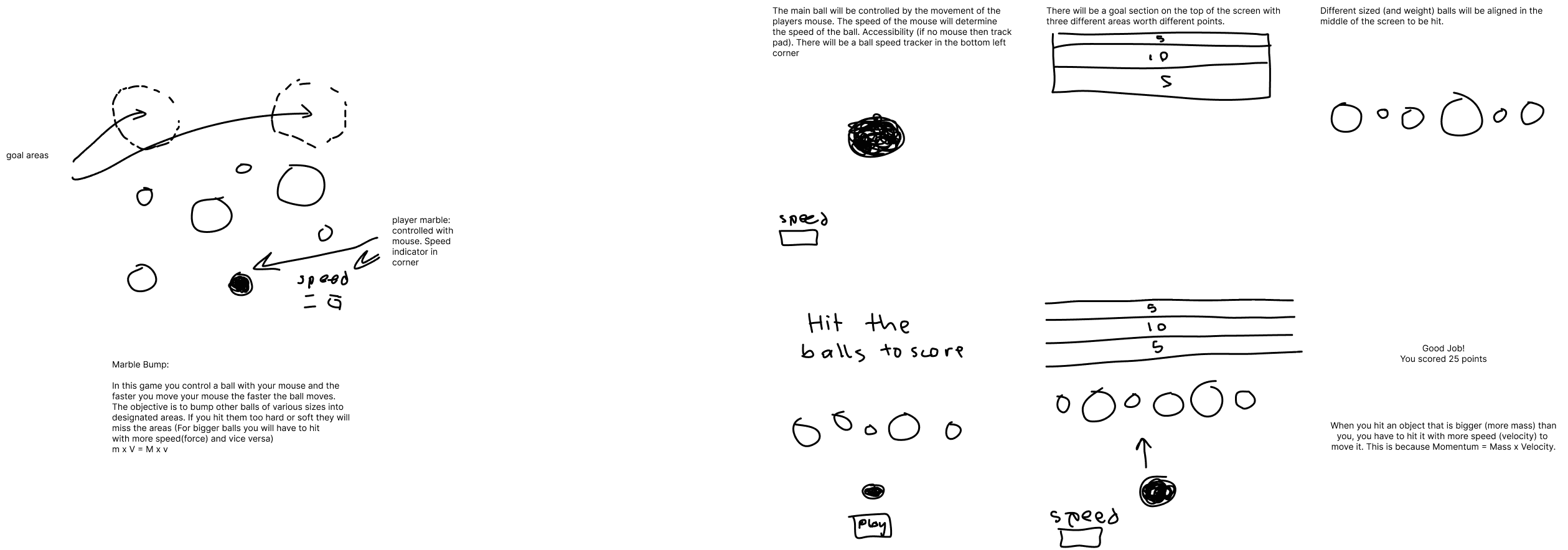
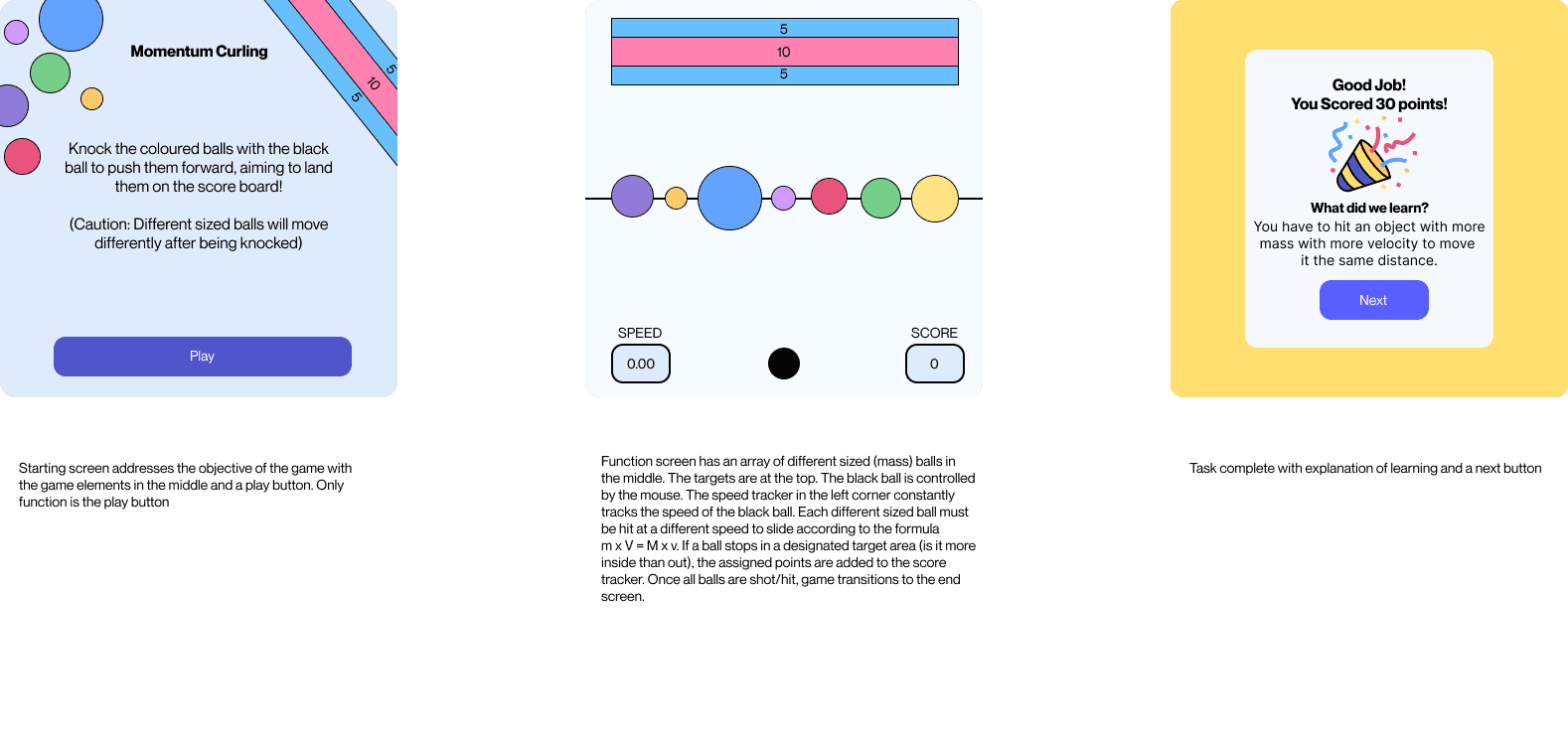


I designed over 150 interactive mini-games which were built using p5.js.
The activities cover topics such as gravity, energy, motion, randomness, and basic programming logic. Inspired by hands-on science experiments, found in CrunchLabs kits, and translated into digital systems that respond to user input.
The experiences are intentionally short and replayable, allowing students to experiment and challenge themselves.
Coordination
Development
In addition to designing the games, I organized the full activity library, structured the progression of concepts, and led the development across the project.
All games were written with readable, modular code so students could inspect, modify, and extend them. Programming was treated as a tool for understanding systems rather than a technical hurdle.
Project Management
Coordinating over 150 activities required clear structure and strong ownership of process.
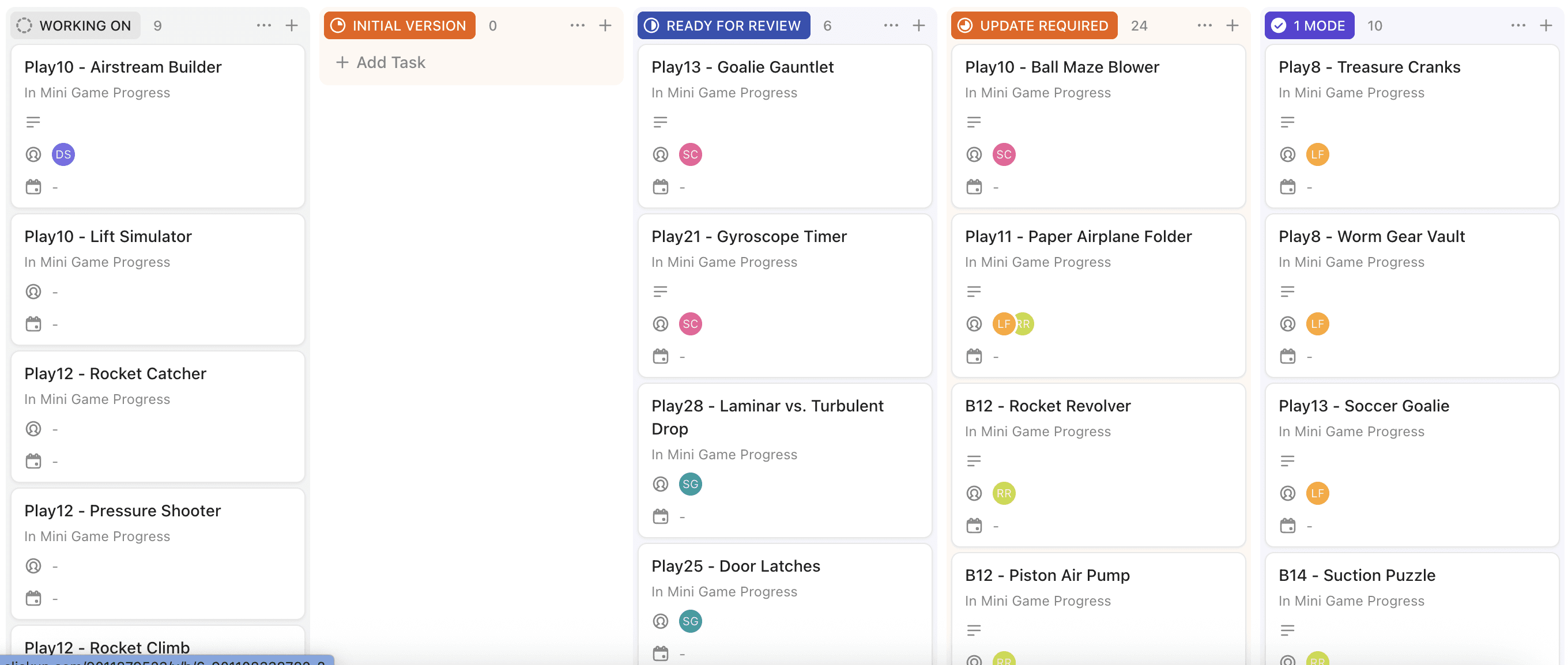
I reorganized and managed the project workflow using ClickUp, defining task structure, priorities, and handoff points between design and development. In a fully remote environment, this system helped maintain clarity and momentum, allowing individual games to evolve without breaking consistency across the larger system.
Status
Science Studio Play was developed as a complete interactive learning system for classroom and personal use. While the project did not reach public market release due to broader organizational and go-to-market decisions, it represents a focused exploration of interaction-first learning design.
Reflection
Designing Science Studio Play highlighted how closely learning, communication, and iteration are connected.
Teaching through play required ideas to be tested quickly, refined often, and communicated clearly through interaction rather than instruction. The project reinforced the importance of treating design as a funnel, where early experimentation reveals what engages, iteration clarifies what confuses, and testing exposes where concepts break down.
Clear systems and feedback loops made it possible to scale the work without losing intent.